

Google Ads on Crack?
I’ve been running ChatGPT ads for various clients this autumn, following the launch of OpenAI’s Ads Manager on August 31. So far, the results are impressive. And after years of managing online advertising campaigns, the simplicity of setting up and managing ads makes a welcome change.
In this post, I explain how running ads on ChatGPT works and why I believe Google’s days as the world’s #1 advertising platform might be numbered.
Why Google Search Ads Have Been So Hard to Beat
Imagine you sell oranges. On TikTok or Instagram, you can create beautiful ads that inspire a desire for your product: freshly picked fruit, sunlight falling across an orchard, a glass of juice that practically pours itself out of the screen… With the right creative and a convincing offer, such ads can work very well.
But first, you need to interrupt someone who was busy doing something else (i.e. scrolling). Then you need to make them interested enough to visit your website, get past the dreaded GDPR cookie banner and actually make a purchase.
With Google Search ads, you can reach someone typing “buy oranges online.” They already want your product. Even better, they already know they want your product. You can spend less effort explaining why oranges belong in their life and more effort explaining why they should buy yours.
That buying intent is a big reason Google Ads has worked so well for many advertisers. Generally, I’ve seen significantly lower costs per acquisition there than on social advertising platforms.
ChatGPT Ads Add Context to Buying Intent
Now imagine that your potential orange buyer has a conversation with an LLM instead of entering a three-word search phrase. They explain that they want fruit delivered to their office in Berlin. There are 20 people in the team, deliveries should arrive on Mondays, and they would prefer organic produce. “Buy oranges online” suddenly looks like a rather incomplete brief!
That is what makes conversational advertising so interesting. A conversation can reveal what someone needs, why they need it and which practical details might determine their decision.
According to OpenAI’s explanation of ad delivery, matching considers conversational context and intent alongside the ad, its landing page and other relevance signals:
“Ads in ChatGPT help advertisers reach users as they explore, compare, and decide within a single conversational experience. By considering the context of the current conversation and, when ads personalization is enabled, select signals from a user’s broader ChatGPT experience, ChatGPT Ads create opportunities to deliver relevant, helpful messages aligned with what users are trying to accomplish.“
Google’s advertising systems obviously use more than keywords too. But the detail people voluntarily provide during a conversation with ChatGPT creates an opportunity to make an ad useful at a particularly relevant moment. And OpenAI’s algorithm seems to know how to turn this into an advantage. In my campaigns so far, click-through rates have been as high as those on Google, if not higher. What impresses me even more is the cost per acquisition: new ChatGPT campaigns are already reaching low CPAs that often took weeks to achieve with Google Ads.
These are observations from my own campaigns, and it is still early days. But they are encouraging enough to make me take this platform very seriously.
Can You Advertise on ChatGPT in Europe?
Yes. OpenAI expanded ChatGPT Ads to 31 European markets, with self-service access available since August 31, 2026. These include Germany, Austria, Spain, France, Italy and the Netherlands.
Do You Still Need a Consultant for This?
Google Ads has enough settings, recommendations and campaign types to keep an entire generation of search marketing consultants employed. Myself included. And, in my humble opinion, some of Google’s own recommendations seem rather more enthusiastic about increasing spending than improving return.
Without experience, it can be difficult to figure out which settings suit your campaign and what difference they actually make. I’ve heard more than one client say “I thought I could do this myself” after burning through their budget and turning to a consultant for help.
My experience with ChatGPT Ads has been different. Once the account and assets are ready, putting a campaign together takes just minutes, with refreshingly few settings. While the reduced workload might not be ideal for consultants, it’s certainly an advantage for advertisers.
How to Run Ads on ChatGPT
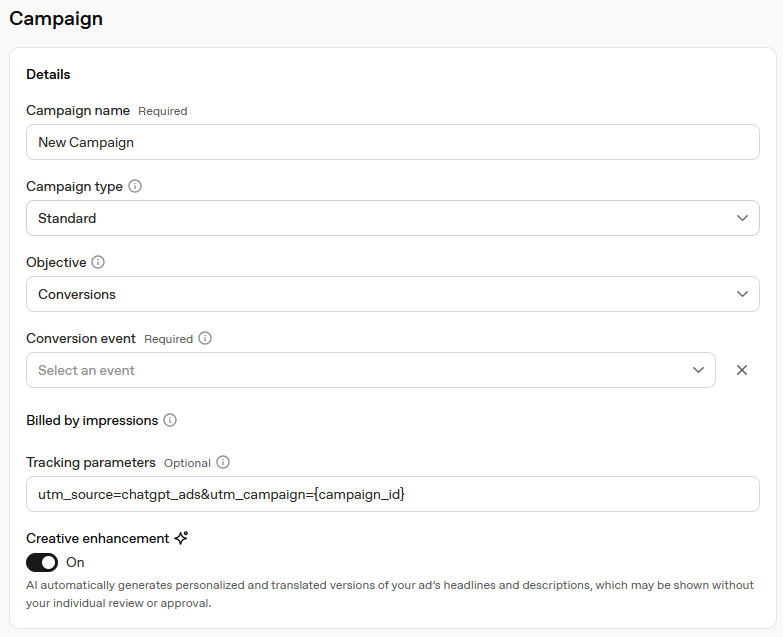
First, you need to open and verify your advertiser account at OpenAI Ads Manager. I also recommend setting up conversion tracking to measure purchases and other conversion events on your website. OpenAI provides a measurement pixel and Conversions API, and you can add UTM parameters to your ad URLs for your existing analytics.
The basic process of running ads is rather straightforward:
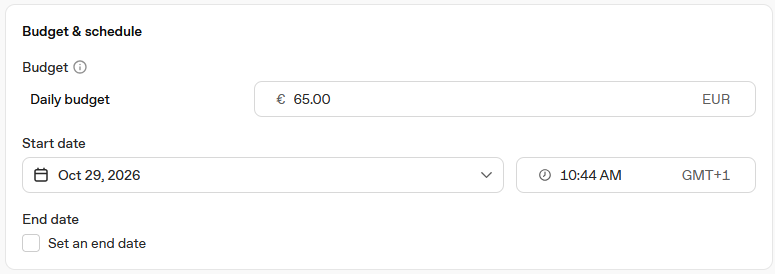
- Choose your objective and budget: current objectives include views, clicks and conversions. OpenAI’s campaign setup guide currently lists a €15 minimum daily budget for euro accounts.
- Decide whether to enable creative enhancement: this lets AI personalize and translate your headlines and descriptions. But beware – the resulting versions may run without your individual review or approval.
- Set your target locations and platforms: you can select supported locations and choose between desktop web, Android app or web, and iOS app or web.
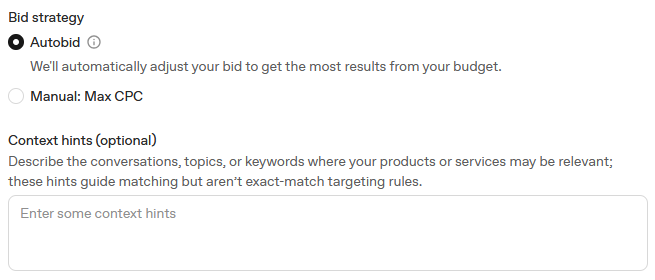
- Create your ad groups: organize related offers and add useful context hints (more about this below).
- Add your creatives: upload a square image, a title of up to 32 characters, a description of up to 54 characters and your landing page URL. Since October 26, multi-image ads with four to six square images are also available in open beta.
- Submit & monitor your ads: in my experience, ad review is usually quick, and approved ads can start delivering within minutes. I’ve also noticed that OpenAI Ads sometimes spends the entire daily budget in a short period rather than spreading it out over the day.
Here’s what setting up a ChatGPT campaign currently looks like:
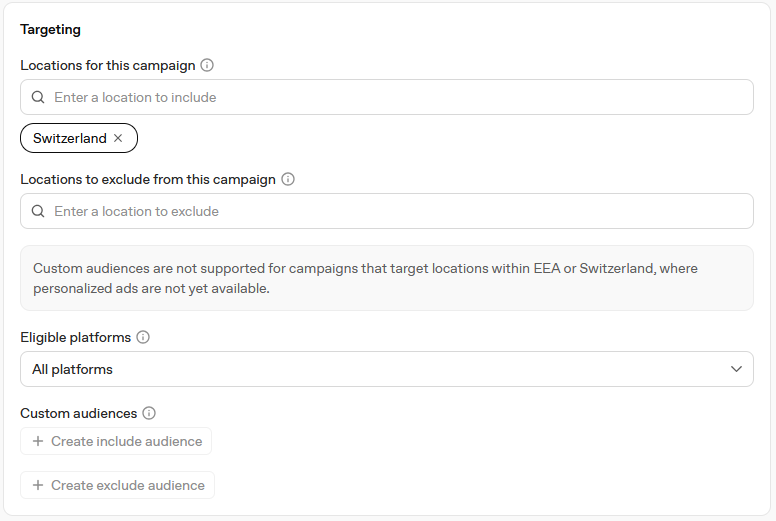

Some new accounts initially have access only to their home market, so check eligibility before planning an international campaign.
How to Use Context Hints for Targeting
One interesting feature is the ability to provide context hints. Instead of selecting interests, keywords or demographic categories, you simply describe the conversations in which your offer might be relevant.
For our hypothetical orange business, that could be:
Someone looking for a regular fruit delivery for their office, comparing suppliers or discussing healthy snacks for their team.
That gives the system more to work with than “oranges” by describing situations where your offer could be relevant.
As OpenAI explains, hints only guide relevance:
“Describe the conversations, topics, or keywords where your products or services may be relevant; these hints guide matching but aren’t exact-match targeting rules.”
Hence, for example, mentioning a location in a hint does not replace setting your geographic targeting.
What Do ChatGPT Ads Look Like?
The single-image ads I’ve been working with so far are compact – there isn’t much room to waste. Some of my best results have come from using the square image for large, readable text. It gives the message a better chance of catching attention, even at a small display size.
But of course it depends on what exactly you are advertising. In other cases, a product photo might do a better job. The important thing is that the image remains understandable when it is small. Also, the platform is still changing: multi-image ads launched in open beta just this week, on October 26, and they provide more room to get your message across.
Should Google Ads Be Worried?
ChatGPT Ads is currently the easiest advertising platform I’ve worked with, by a considerable margin. That is good news for advertisers. For consultants whose main selling point is knowing which buttons to press, perhaps less so.
As for Google, the pressure is worth watching. Following Alphabet’s October 28 earnings report, Reuters reported an approximately 10% after-hours share-price fall, alongside weaker-than-expected advertising revenue and concerns about spending on AI infrastructure.
Google’s advertising revenue still grew year over year, so this is about falling short of expectations, not revenue already shrinking. But I do think conversational advertising could become a serious competitor for budgets that previously went to search. If people increasingly work through buying decisions with AI assistants, advertisers have a good reason to be present there.
I’m certainly paying attention.
Need Help Advertising on ChatGPT?
Would you like to run ChatGPT ads in Europe and work with an experienced advertising consultant?
I can help with campaign setup, ad copy, creatives, conversion tracking and ongoing optimization. Get in touch and tell me what you would like to advertise.
